
Scaling printed OLED manufacturing means increasing the light-emitting area while maintaining consistent performance across the panel. Inuru has progressed from commercial illuminated labels to repeatedly producing smartphone-sized OLED panels with reproducible electrical parameters, showing that the manufacturing process can remain stable as the active area increases.
The move towards larger printed OLED did not begin with a larger panel. It began with smaller commercial products that could be manufactured repeatedly, tested under real production conditions and improved from one production run to the next.
For Inuru, illuminated labels became that starting point. They provided a practical environment for developing the manufacturing process, understanding where variation occurred and building the process control needed before moving to larger light-emitting areas.
OLED labels provided a practical starting point because their operating requirements were very different from those of conventional consumer displays. When Inuru began developing its approach in 2012, this difference helped shape the applications we chose to pursue: use cases where printed OLED could already create value without first having to meet the lifetime and performance requirements of a smartphone display.
A smartphone display may operate for hours every day over several years, while an illuminated label may only need to light up for a few seconds during an interaction with the product. This made labels a much more realistic first application for printed OLED, because they could deliver a visible, useful function without requiring the same operating lifetime as a conventional display.
Labels also offered clearly defined use cases. The OLED could illuminate a logo, highlight part of a design, respond to touch or become part of the product presentation. This gave Inuru a practical way to develop the technology around specific product interactions rather than trying to solve the much broader requirements of a full display from the start.
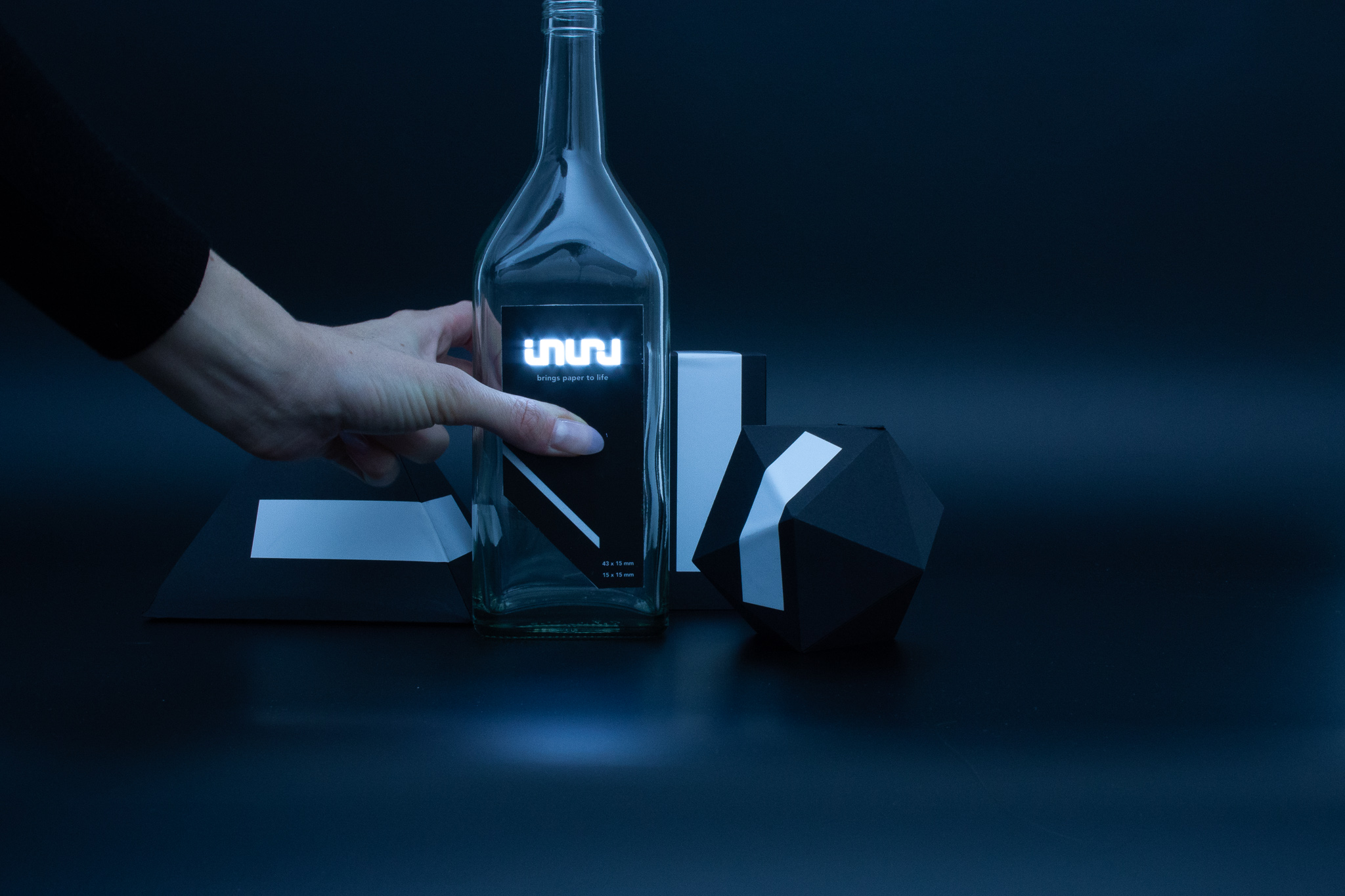
Commercial production made it possible to evaluate printed OLED in a way that laboratory demonstrations could not. In one earlier quality-control test, every panel emitted light, yet not all of them met the requirements for a usable product. That distinction became important: a panel lighting up was only the first step.
For a printed OLED to become a usable product, it has to do more than emit light. It needs to perform within the required electrical and visual parameters, and it needs to do so consistently. Commercial production therefore shifted the focus from whether an individual OLED worked to whether the manufacturing process could deliver the required performance repeatedly.
Repeated production gave Inuru a clearer view of where variation could enter the process and which stages required tighter control. Each production run provided more information about the relationship between manufacturing conditions and the performance of the finished OLED, helping the team refine the process over time.
The next question was whether the process developed through smaller commercial products could be extended to a much larger light-emitting area.
As the light-emitting area increases, the manufacturing process has to remain stable across a larger surface. Variations that may have only a limited effect on a smaller OLED can become more significant when the same process is applied over a larger panel.
Particles, material impurities and small changes in printing conditions can all influence the finished OLED. As the panel becomes larger, there is simply more surface over which one of these factors can affect the light-emitting area, making process stability increasingly important.
Scaling printed OLED is therefore not simply a matter of enlarging the design. The manufacturing process has to remain controlled across the full panel and continue to deliver consistent performance as the light-emitting area increases.
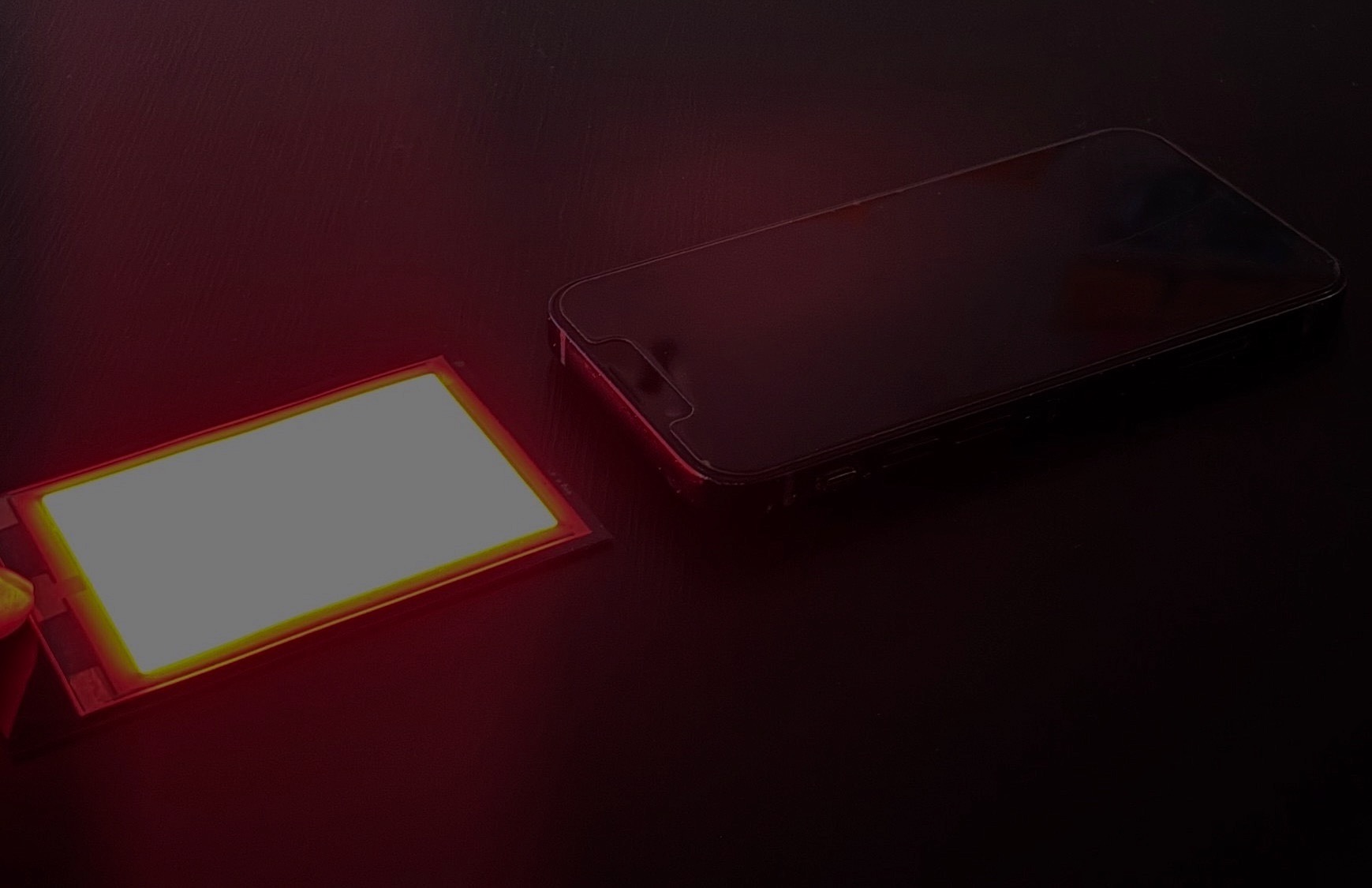
“Smartphone-sized” describes the physical dimensions of the printed OLED panel, not a finished smartphone display. The panels produced on Inuru’s manufacturing line near Berlin emit a single colour and are used to demonstrate how the manufacturing process performs when the light-emitting area is increased substantially.
The significance of this milestone lies not simply in producing a larger panel, but in increasing the light-emitting area while maintaining reproducible electrical parameters across repeated production runs.
A finished smartphone display would require additional functionality and performance suited to everyday use. Here, the focus is on manufacturing capability: demonstrating that a process developed through smaller OLED products can be applied consistently across a much larger surface.
Increasing the printable area is only one part of scaling printed OLED manufacturing. The next priorities for Inuru are lifetime and robustness: extending how long the panels can operate and improving how reliably they maintain their performance in use.
The performance requirements will depend on the application. A light source used for brief interactions does not need the same operating lifetime or usage profile as a surface designed to emit light for longer periods or more frequently.
Further development will therefore build on the existing manufacturing process through improved materials and continued refinement of panel performance. The goal is not simply to make printed OLED larger, but to make larger formats suitable for a wider range of real-world applications.
Larger printed OLED surfaces could extend the role of light beyond small illuminated details and make a greater part of the product itself light-emitting. This opens up possibilities for applications where light needs to be integrated directly into a thin, flexible surface rather than added as a separate component.
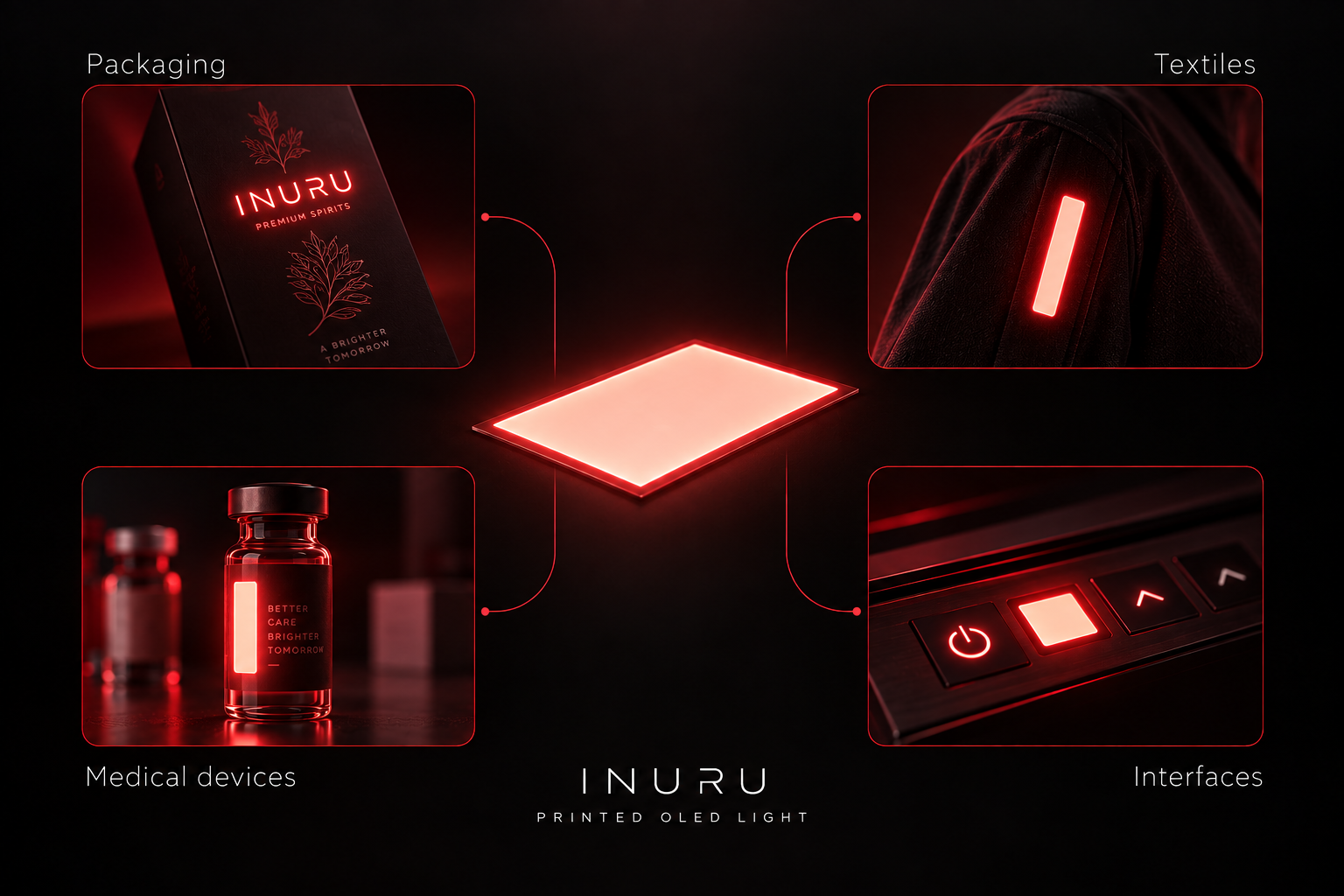
Potential applications include packaging, textiles, medical devices and other products where thinness and flexibility are important. Depending on the use case, the light could highlight information, indicate where to interact with a product or provide illumination directly where it is needed.
Each application will place different demands on the OLED, including size, lifetime, brightness, power and mechanical robustness. Developing larger panels is therefore not about targeting one specific product category, but about creating a manufacturing foundation that can support a wider range of use cases.
Inuru’s development strategy was to establish and understand the manufacturing process before increasing investment in more expensive materials and equipment. Working first with relatively low-cost materials allowed the team to focus on improving the process itself rather than relying on higher-cost inputs to compensate for manufacturing inconsistencies.
Once the process was better understood, improvements in materials and equipment could be introduced on a stronger foundation. This approach becomes increasingly important as printed OLED moves towards larger and more demanding formats.
Printing is central to Inuru’s approach because scaling OLED is not only about improving device performance, but also about how the technology can be manufactured for different products. Applications such as packaging, textiles and other everyday objects operate under very different production and cost requirements from conventional consumer electronics.
Bringing printed OLED into these applications requires a manufacturing approach that can adapt to different formats, shapes and integration needs. For Inuru, printing provides a route towards producing OLED light sources in a wider range of configurations while keeping the process compatible with different product requirements.
Scaling from small commercial labels to larger printed panels is one step towards extending this manufacturing approach to larger light-emitting formats.
The move from illuminated labels to smartphone-sized printed OLED panels reflects a broader goal: developing a manufacturing platform that can support different formats and product requirements rather than a single application. Commercial products provided the foundation for refining the process, while larger panels extend that process into a more demanding scale.
For Inuru, smartphone-sized printed OLED is therefore not an endpoint. The long-term challenge is not simply to print bigger OLEDs, but to scale the manufacturing process while preserving the consistency, performance and flexibility needed for real products.
Can printed OLED be manufactured in larger sizes?
Yes. Inuru has repeatedly produced printed OLED panels approximately the size of a smartphone screen with reproducible electrical parameters. As the light-emitting area increases, however, maintaining process stability across the full panel becomes increasingly important.
Why is repeatability important in printed OLED manufacturing?
A single working OLED shows that the device can function. Repeatable production shows that the manufacturing process can deliver comparable performance across multiple panels and production runs, which becomes increasingly important as the OLED area increases.
Are Inuru’s smartphone-sized OLED panels smartphone displays?
No. “Smartphone-sized” describes the physical dimensions of the printed OLED panel. The current panels emit a single colour and demonstrate manufacturing capability at a larger light-emitting area.
What are the next challenges for larger printed OLED panels?
The next priorities include improving lifetime and robustness while continuing to refine panel performance and manufacturing consistency. The required performance will depend on the intended application and how the OLED is used.
Interested in integrating thin, flexible OLED light into a product or exploring a new application? Talk to our team about your project and the possibilities of printed OLED.
Last updated: September 2026
SOURCES:
(1)https://www.energy.gov/cmei/ssl/oled-basics
.svg)


